Check this out - Albert Lim from Fallout Central interviews such greats as Bobby Lee, Kaba Modern, Apl.de.ap (Black Eyed Peas), Jabbawockeez, Eric Hsu (Johnny Hi-Fi) and Jade Kira, Russell Peters, Quentin Tarantino, Jack Yang (Cashmere Mafia), and Ron Jeremy. Why Tarantino and Jeremy were there is open to conjecture, but we're glad our friend Albert Lim got to interview these amazing people. He even got Jack Yang to tell us his own secret for his hair.
 Love is Growth / Butter&Gun$ EP
Love is Growth
Taiyo Na (birth name: Taiyo Ebato), 25, is the curator of the aforementioned SULU Series (a monthly showcase of Asian American talent at the Bowery Poetry Club), combines hip-hop and folk/acoustic/soul in his debut release. His voice reminds me of Korean Am rapper/poet Denizen Kane's--raspy, somewhere between rap and song, weaving through poetry and music. Through his lyrics he articulates life on the grind, the push forward, the growth in love:
Pain is my dealer who break me with the language
Bless me with the insight to illuminate my canvass
My hurt got a honey, so you can comprehend this
Rock it like a rosary and walk with the anguish...
Taiyo Na - Love is Growth
Heavy on acoustic guitar and strings, the album features the creative input of an arsenal of East Coast Asian American artists--among them, Koba, Vudoo Soul, Craig Chin, Kevin So, and, my personal fave, Emily Chang (formerly of I Was Born With Two Tongues) lending her addictive voice on "Moonlight City (Reprise)." Other highlights include "Kasama," an ode to a sister in the struggle; "Lil' Tookie," in remembrance of Stanley "Tookie" Williams, the Crip-turned-peace activist sentenced to death by the state of California; and "Immigrant Mother (Lovely to Me)," Taiyo's ode to his, believe it or not, immigrant mother.
However, I definitely enjoyed the first two-thirds of the album the most; the last few songs, where Taiyo dips more into the acoustic-folk part of his repertoire, begin to blend together and lose the distinctiveness of the rest of the LP. Other than that, though, Love is Growth is a solid debut from an artist with much in store for the future.
Butter&Gun$
Blue Scholars, the Seattle, WA hip-hop duo of emcee Geologic (George Quibuyen) and deejay/producer Sabzi (Saba Mohajerjasbi), has recently gained national prominence through their distribution partnership with legendary label Rawkus Records and their 2007 sophomore album, Bayani. Since then, they've released two digital-only EPs, the first revolving around "Joe Metro," Bayani's closing track and Geo's ethnographic narration of riding the Seattle buses. (See my post on the somewhat surprising ballad, "Southbound.") Butter&Gun$--referring to an economic model that weighs a government's spending on military versus social service--operates more as a single for "Loyalty," a sonic ode to the group's followers and, in my opinion, the best track hands down off of Bayani.
Aside from the original version of the song, the EP features a reconceptualization of the theme, chopping-and-screwing segments of the original (I'm kinda ambivalent about that) amidst Geo's unusually rapid-fire delivery:
They put us in competition to cause affliction with opposition
The friction is part of their fiction, they’re looking for pots to piss in
Watch the bosses up in the loft laughing, upping the cost of living
To cop a billion while the cops are killing ‘em off, women and children
Politicians who mock religion and talk tradition to all, just wishing
That all the listeners fall victim, the pistols are drawn, the sinister laws
Is killing the cause, the citizens march, the sinners will start repentance
The minister calls deliverance, guerillas defending their villages...
Blue Scholars - Butter&Gun$ (Loyalty Pt. II)
The other original song, "27," recalls Geo's childhood as a military brat, developing a penchant for hip-hop in Honolulu. As always, Sabzi laces the beats with an eclectic mix of jazz, soul, and funk as Geo paints personal experience and popular struggle in the same breath. Butter&Gun$ is best described as a continuation of Bayani-- a fitting showcase of their talent, yet built upon the same formula that most of their recent songs follow. Nevertheless, Blue Scholars has been getting lots of attention in recent years and I'm excited to see where they'll take their music.
So a number of AAA members have been circulating a Facebook note written by a CC senior who attended CUCSSA's screening of Finding Li Wei and found some of the film's comments blatantly racist. Here is that note:
To the Members of the Columbia University Chinese Scholars and Students Association (CUCSSA), and to those it may concern:Sadly, no AAA members were in attendance; but anybody who was there is welcome to comment.
I am writing this note in response to the performance of "寻找李伟 (Finding Li Wei),” a Chinese drama (spoken in Mandarin) performed on the night of Saturday, April 26th, 2008 at Teacher's College, Columbia University. This was one of the most hurtful and disappointing experiences for me during my time here at Columbia University in the City of New York. I was so devastated to hear the racism and the racist slurs against Black people in the show itself. Specifically, there was a racist comment made by one of the characters in the show and it was targeted towards Blacks in Harlem. I went home crying after hearing one of the characters saying, "I feel like Americans are quite nice, but actually no! We need to get rid of those Black people in Harlem. I'm terrified by Black people!" which was followed by an uproar of laughter in the audience. Not only did the character's words hurt me, but so too did the outburst of laughter by nearly 99% of the people in the audience, who are Chinese students at Columbia University.
I am deeply upset and saddened that Columbia Chinese Scholars and Students Association would be associated with and originally produce and write something so racist, especially at a time when the 2008 Beijing Olympic Games, an event that people from all across the globe and people of all races will be traveling to China to see. As a black Columbia student and East Asian Studies major, I have dedicated so much of my energy to learning about Chinese language and culture, and even spent quite some time in China for study abroad. I am so saddened that this act of racism occurred on my campus and in such a public, blatant manner, in a play that was written and produced by the Columbia University Chinese Scholars and Students Association (CUCSSA). In recent weeks, I too have been coping with the loss of fellow student, Minghui Yu of the Graduate School of Arts and Sciences, who was also an active member of the CUCSSA. Although I realize that the physical harassment and death he endured on April 4th, 2008 was at the hands of a West Harlem youth, the ethnic background of his assailant is not a justification for a generic attack on the entire African Diasporic community in Harlem.
Prior to the beginning of the show, I was so excited to attend and invited five of my friends to attend this event. I was so excited to be there. Not only that, but I also cancelled an event last night that I am group organizer and creator of, called the Columbia University Chinese Karaoke Group, since the event conflicted with yesterday's performance of "Finding Li Wei." To make a long story short, I sacrificed my own event to attend this one. In hindsight, I would have rather gone to karaoke.
This incident of racism insulted me and the entire African-American community at my own university and in front of my own eyes! This prejudice will not be tolerated. The fact that these racist comments were spoken in Chinese does NOT desensitize the issue. To my fellow audience members: I left crying while all of you kept laughing and snickering. I am so saddened that "Chinese scholars" would write a screenplay that would instigate racism in our Columbia community. I am also especially disappointed, hurt and overwhelmed by the fact that a "friend" of mine, Guo Rui SEAS '08 was the playwright.
Columbia University is one of the most prestigious universities in the world, and it really needs to enforce its supposed intolerance of racist acts on campus. Within the past year alone, there have been many hate crimes on Columbia's campus, with only a few gaining attention by the administration. I am so saddened that yet another one occurred. Members of the CUCSSA, please remember that there are fellow students of the African Diaspora and from Harlem who attend the SAME university as you. Show respect, and STOP THE RACISM!!!!!!!
Update: In hindsight, it's a shame that the Minghui Yu / Bwog discussion didn't take off, because this issue definitely could have been worked into it.
Copied & pasted from the AAA website:
After a 2 hour election deliberation marked by tears and laughter, I would like to congratulate the new AAA board of 2008-2009:
Chair - Aretha Choi (BC 2010)
CC/SEAS Vice Chair - Shilpa Vadodaria (SEAS 2010)
BC Vice Chair - Katie Wang (BC 2010)
Secretary - Daniel Nisball (SEAS 2009)
Treasurer - Jeremy Tapp (CC 2011)
Political Chair - Jia Ahmad (CC 2011)
Community Chairs - Lena Fan (CC 2010) & Mei Li Zhou (BC 2011)
Social Chair - Patrick Chang (SEAS 2011)
Publicity Chair - Corinne Fukayama (SEAS 2010)
Historians - Eddie Kang (CC 2011) & Lizzie Shen (CC 2011)
USCC Representative - Evan Omi (CC 2011)
You all have my love. Stay classy.
- Calvin, former Chair
Stay classy... San Diego?
This concludes Calvin's Harold & Kumar 2 interview series. Enjoy!
Jon Hurwitz & Hayden Schlossberg, writers and directors of Harold & Kumar 1 & 2


Multicultural colors include:
- Golden Beige
- Beige
- Tan
- Tawny
- Bronze
- Terra Cotta
- Mahogany
- Sienna
We kid you not.
 At long last, Calvin's interview with Harold and Kumar 2 actor Kal Penn (... with the help of some other very excited kids)! Read up, this comes to The Blaaag only once in a while. Excuse the looks on Mr. Penn's face, I'm sure he was dying for some of that delicious Fiji water right next to him (in the picture beneath the interview).
--
Kal Penn walks in smiling. The table bristles with excitement as the first question is asked.
So how did you feel about doing a sequel to the first Harold & Kumar film?
KP: I was surprised there was even a sequel. The first one didn’t do well in theaters or DVD marketing. However, I believe that the subsequent reaction over time gave New Line Cinemas enough money to do a sequel. Therefore, this sequel is dedicated to the fans who made this happen.
I thought the 200 million dollars was made from the first film?
KP (incredulous): Well if that’s the case, I haven’t seen that money! I wouldn’t be wearing the same clothes I’m wearing now. In fact (laughing), I would have to hire a lawyer because we definitely didn’t have that much money to put into the sequel.
Was the purpose to put the heroes into the minority?
KP: The purpose was to make an All-American buddy movie. It could be labeled as a teen film, a satire, or a stoner comedy. It may be all three or none of those things. That’s why the audience loves it: you see characters in situations you haven’t seen them in before, and it’s not because of their ethnicity, it’s because of the good writing.
Is there a little bit of reality in which the racist imagery in the film is grounded?
KP: Well it’s funny, because in one of the first scenes in the airport where Harold and I are waiting in line, I get pulled out because of I’m a “suspicious man of color.” It goes back to an actual story where the director and writer of Harold & Kumar, John Cho, and myself were waiting in line in Austin, Texas. So they go through, no beep. John [Cho] goes through, no beep. But when I went through without beeping, I of course still got pulled out of the line by TSA officials.
So they search me and pat me down and do all the security checkpoint stuff and let me go. Then one of the writers [for Harold & Kumar] came up to me and was like “I have something to tell you that might piss you off.” And then I was like, “I’m already pissed off. How can it get any worse?”
Well the thing was that prior to meeting us at the airport, he was coming back from a weekend camping trip and had a hunting knife on him that he forgot to take it out of his bag as he was checking into airport security. However, the TSA officials were so focused on me, as that “suspicious man of color,” that they didn’t even pay attention to the hunting knife.
So yeah, all ethnicities have gone through it before. This sequence helped with writing the opening scene, but in a light way that John & Hayden would write it.
Do you feel the burden of it being marketed as an Asian American film?
KP: I don’t think that is the appeal; I think the appeal is to a wider audience. I remember back in the day I wouldn’t see anyone like me except for Indiana Jones & Temple of Doom or Apu [from the Simpsons]. Now I think [Asian Americans] are of course going to get excited about seeing people looking like them. However, the movie is also cool in that it still appeals to all kinds of people who enjoy different appeals. Frat boys enjoy it, Asian Americans enjoy it, etc.
You see, both Harold & Kumar in the film went to Columbia (Calvin cheers, Kal stops to nod in approval), and they’re both smart. Just that one’s a banker, and one’s not sure about medical school. It’s not that one’s smart and one’s dumb or one’s clueless and one’s isn’t. Both are bright, it’s just different personalities. However, it’s weird that people call me Kumar in real life.
So you have two careers now?
KP: Yes. One’s serious and one’s comedic.
Does being Kumar prevent you getting parts like in The Namesake?
KP: Actually it helped because Mira Nair’s son is a big fan of Harold & Kumar. When I heard the casting call for “The Namesake” I begged the casting department for the role but I never got a reply back. Apparently Mira already had a short list of actos she wanted for the part of Golgol and I definitely wasn’t on it. However, thanks to my involvement in Harold & Kumar, every night and every morning Mira would hear to no end from her son who begged her constantly to “get Kumar in The Namesake.” So eventually she relented and I got the chance to audition and eventually work with a very smart writer & director.
What are you doing now?
KP: I’m working on a TV show called House. I play a regular called Lawrence Kutner who likes the unorthodox way of doing medical stuff.
Anyone you want to work with?
KP: Natalie Portman, Mira Nair, Spike Lee, Larry Clark.
Do you have to be more selective now as an actor?
KP: That’s the goal of the actor: To build up your resume to get the foot in the door. You think we’re doing well after Harold & Kumar, but on the inside it’s actually much tougher. For example, I’m getting older so I can’t do Harold & Kumar 14.
How old are you now? Can you still feel you can do more roles like Harold & Kumar?
KP I’m 30. I still act like I’m 11 though.
Do you feel a responsibility now to break stereotypes as a South Asian American actor?
KP: I don’t feel any responsibility to break stereotypes. I think there’s an acknowledgement you can do certain things in that capacity. But folks don’t realize that this really relies on the writers instead of the actors, which are jobs that the Asian American community doesn’t encourage their people to go into. It’s really good writing that creates those stereotype breaking roles, not good actors.
For sure though, playing fields are definitely getting more diverse nowadays, and Harold & Kumar contributes to that. I can certainly relate to the sense of empowerment.
Does this movie encourage drug use?
KP: No. I think anytime they do use drugs, they screw up, you know? If anything, what’s important about this film is that in any other country we’d get short or imprisoned for making fun of our prime minister, president, king, whoever. Here in this film we make fun of President George W. Bush in such a ridiculous way and that’s okay! And it’s not even an anti-Bush movie or anti-Drug, or an Asian American film. It’s a simple fun film about 2 guys on a journey.
Kal’s agent hounds us for asking too many questions as all of us rush to take pictures with him as he’s wrapping up the last question. To save time, Kal decides to take a group picture and encourages us all to facebook each other for the photo.
Whooo... the below copied from an email again from Jian Zapata.
At approximately, 12:40pm today Senator Richard Burr's amendment to strip FilVets provisions out of S. 1315 was struck down, 56-41.
At approximately, 1:00pm today S. 1315 PASSED its final vote in Senate, 96-1.
THANK YOU to all who contacted their Senators & for all the ongoing support! And above all else, MARAMING SALAMAT to our HEROES, our veteranos.
We are SO close to correcting the injustice for our Filipino veterans. Next steps.. the House!


The walk out demonstration, organized by a group of grad/undergrad students, started at the Sun Dial at noon today. Speakers included professors with expertise on the Middle East, Iraq War veterans (IVAW members), and unreserved students (with reps from Lucha and Columbia Coalition Against the War).
At 2 PM, demonstrators surrounded the Alma Mater on Low Steps (hooded and holding electric wires, a painful reminder of the infamous Abu Ghraib photograph), linked arms, and stood silently for fifteen minutes in a nonviolent protest. Under urgent beckoning, administrators rushed by and watched the scene, ready for any sort of commotion that might arise. Meanwhile, a few organizers remained at the table and read out names of the dead in Iraq.
After the "human chain" broke, the crowd trickled back to the Sun Dial and listened to the name reading. Due to the heat from the burning sun, organizers dutifully passed around cups of water (and divestment petitions).
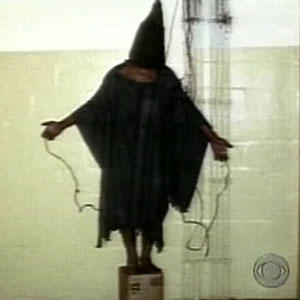


(Change your Facebook photos!)
In case you didn't already put the pieces together after listening to people read out names of the dead all week, read all about Columbia University's protest against the War in Iraq here, here, and here. PC members will be in attendace (our own Ryan Fukumori designed the flyers), so be on the lookout.
